Choosing reliable DDR5 memory for data center operations requires more than comparing advertised speeds. Capacity, error correction, thermal behavior, firmware compatibility, and long-term supply stability can affect every server rack. In China, established memory suppliers serve cloud platforms, enterprise systems, AI clusters, and regional data centers. Their products may include ECC RDIMM and LRDIMM modules, different density options, and support for current server processors.
This introduction presents ten notable Chinese suppliers associated with DDR5 data center memory. The selection considers manufacturing capability, product documentation, testing practices, technical support, and market experience. It also examines practical details, such as module capacities, operating speeds, registered architecture, PMIC design, and compatibility testing. A supplier with impressive specifications may still require careful validation on your chosen server platform. That step is often underestimated.
Real deployment conditions matter. A module running smoothly in a laboratory may behave differently inside a crowded rack at sustained load. Buyers should request qualification reports, warranty terms, traceability information, and samples for burn-in testing. They should also confirm whether suppliers maintain consistent component sources and production standards. Availability can change quickly.
This is not an absolute ranking. Supplier strengths differ by workload, budget, delivery region, and procurement scale. Some companies may offer stronger customization, while others provide broader international support. Independent verification remains necessary. The following overview is designed to help technical teams compare China’s leading options with clearer expectations and fewer costly assumptions. Small details matter. DDR5 adoption is still evolving, and specifications alone cannot guarantee dependable service.
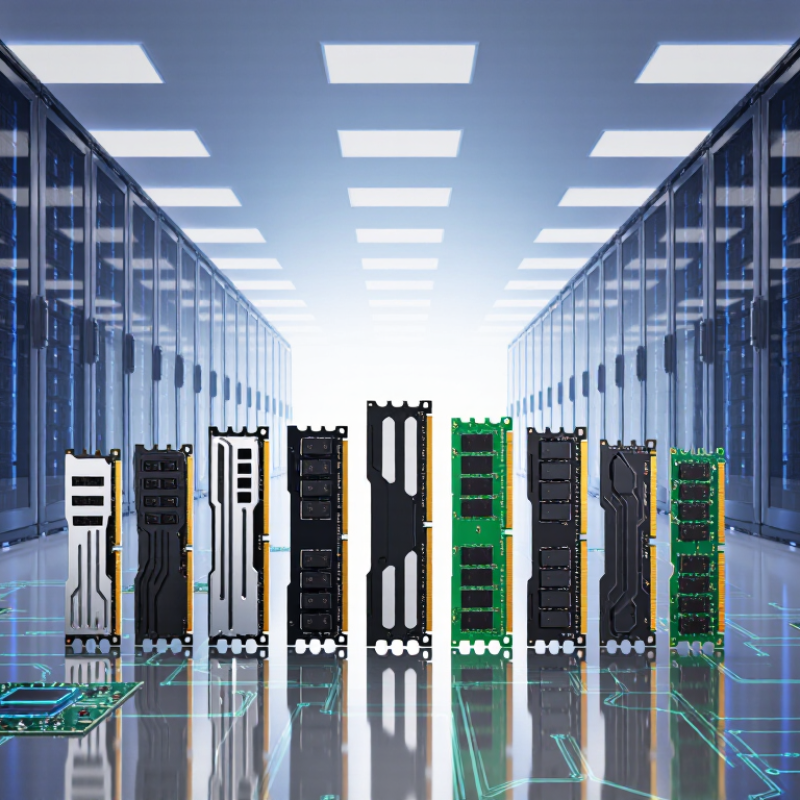
Modern data centers need DDR5 memory for more than higher speed. JEDEC’s JESD79-5 standard defines DDR5 starting at 3,200 MT/s, with higher approved data rates reaching 6,400 MT/s. This wider bandwidth helps servers process virtualization, analytics, and AI datasets with less memory pressure. However, speed alone is a weak buying criterion.
Capacity matters more than many procurement teams expect. Large database nodes may require hundreds of gigabytes or several terabytes of registered ECC memory. DDR5 also moves power management onto each module, improving control but increasing thermal design demands. Airflow becomes practical evidence, not a specification-sheet detail. Uptime Institute’s 2024 Global Data Center Survey reported that 53% of respondents experienced an outage within three years. Memory errors can worsen such events when monitoring is poor. Suppliers should therefore provide ECC validation, module compatibility lists, burn-in testing, and clear firmware support. Lifecycle availability matters too. A cheaper module is not cheaper after repeated replacements. I would not treat this as a perfect rule; workload testing still beats assumptions. Short tests can mislead. Buyers should measure bandwidth, latency, correction events, power draw, and temperature under sustained load. That evidence creates a more reliable DDR5 selection process for modern data centers.
This supplier-neutral comparison uses common DDR5 transfer rates. Theoretical bandwidth is calculated as data rate × 8 bytes per 64-bit memory channel, with no company or brand data included.
Key requirement: Higher DDR5 transfer rates increase per-channel memory bandwidth, helping data centers support memory-intensive workloads such as virtualization, analytics, artificial intelligence, and in-memory databases.
Choosing among China’s top DDR5 memory suppliers requires more than comparing prices and advertised speeds. Data center buyers should verify ECC support, registered DIMM compatibility, capacity options, rank configuration, and thermal limits. A module rated for high frequency may still perform poorly under sustained server workloads.
Ask suppliers for production test methods, failure-rate data, and traceability records. Reliable vendors should identify memory components, firmware revisions, assembly dates, and quality-control checkpoints. Independent testing can confirm error correction, stability, power consumption, and performance across different server platforms. Short sample tests are not enough. Run prolonged workloads at high temperature and near-full capacity.
Supply continuity also matters. Review monthly output, backup component sources, delivery history, and replacement procedures. Technical support should provide clear validation reports and respond with measurable evidence, not vague assurances. Check compliance documents, warranty terms, data-handling practices, and export requirements for every target market. These details can affect deployment schedules.
A low quotation deserves careful questioning. It may reflect reduced testing or limited support. No scorecard is perfect. Supplier evaluations can also overvalue laboratory results while overlooking field service. Request references from comparable data centers, but verify them independently. The strongest assessment combines engineering tests, factory audits, contract review, and a small pilot deployment before wider procurement.
China’s Top 10 DDR5 memory suppliers are best assessed through engineering evidence, not shipment claims. The profiles cover chip design teams, module manufacturers, testing specialists, and enterprise memory providers. Each supplier is examined for ECC support, capacity options, thermal control, firmware compatibility, and local validation experience. These details matter inside a server rack, where airflow is limited and memory errors can interrupt costly workloads.
TrendForce’s 2024 server DRAM analysis projected DDR5 adoption to approach 40% of server memory demand. JEDEC’s DDR5 standard supports data rates up to 6,400 MT/s in its baseline range. Therefore, the ten profiles compare speed with practical stability. They also review registered DIMM design, error correction, dual-rank performance, and compatibility with major processor platforms, without relying on promotional language.
The ranking is not flawless. Public data remains uneven, especially for private manufacturers and smaller module suppliers. Some companies publish strong laboratory results but provide limited field evidence. Others show modest specifications yet deliver dependable performance in regional data centers. Procurement teams should request burn-in records, failure-rate data, traceability documents, and multi-month validation results. Omdia’s memory market research also highlights continuing price and supply volatility, making contract flexibility important. A lower quoted price can become expensive when replacement stock is unavailable.
A serious comparison of China’s top ten DDR5 memory suppliers should examine technology, capacity, and reliability together. DDR5 ECC RDIMMs support stronger error correction and better signal integrity for database, virtualization, and artificial intelligence workloads. Suppliers using registered designs, on-die ECC, and programmable power management can provide steadier performance under heavy demand.
Capacity matters in real server rooms. Common modules range from 32GB to 128GB, while high-density 256GB options suit memory-intensive platforms. However, larger capacity does not automatically mean better value. Buyers should check motherboard compatibility, rank structure, speed stability, and thermal behavior at full population.
Some suppliers offer custom SPD programming and lot-based validation. That detail can prevent costly deployment delays.
Reliability requires more than a datasheet. Look for extended burn-in testing, temperature cycling, power fluctuation tests, and automated memory diagnostics. Clear serial-number traceability also helps teams investigate field failures. Suppliers with controlled component sourcing and documented quality systems are easier to audit.
Firmware and BIOS compatibility deserve attention too. Often overlooked.
In practical evaluations, stable operation at sustained load matters more than peak benchmark results. A module may pass a short test yet show intermittent errors after hours of heat exposure. This is where supplier response time, replacement procedures, and technical support become measurable advantages. Capacity claims can also change across production batches, so independent sample testing remains wise. My assessment is not perfect; long-term failure data is still difficult to compare openly across suppliers.
DDR5 memory now supports virtualization, high-performance computing, analytics, and AI infrastructure. The IEA’s Energy and AI report projects data center electricity demand could reach about 945 TWh by 2030. Higher memory capacity can reduce storage traffic, but it also increases power and cooling requirements. Procurement teams should compare performance per watt, not speed alone.
Start with workload profiles. Database servers often need large-capacity ECC RDIMMs, while simulation clusters may prioritize bandwidth and balanced channel population. Check supported capacity, rank configuration, error correction, and validated operating speeds. JEDEC’s DDR5 specification defines higher density and improved reliability features, but actual performance still depends on the server platform and firmware.
Small details matter. Verify module height, thermal sensors, spare inventory, and delivery consistency. Ask suppliers for test reports, failure-rate data, and change-notification policies. Uptime Institute’s 2024 Global Data Center Survey continues to identify power, cooling, and operational resilience as major concerns. A cheaper module can become expensive after repeated troubleshooting. I have seen procurement spreadsheets ignore firmware compatibility. That mistake is easy to repeat. Forecast demand over three to five years, yet avoid buying maximum capacity too early. Memory prices, platform support, and workload requirements can change faster than expected.
| Rank | Supplier Profile | Primary Supply Region | DDR5 Module Type | Typical Capacity Options | Common Data Rates | Key Technical Features | Typical Data Center Applications | Procurement Considerations |
|---|---|---|---|---|---|---|---|---|
| 1 | Profile A: Enterprise RDIMM Specialist | Eastern China | DDR5 ECC Registered DIMM (RDIMM) | 32GB, 64GB, 128GB | 4,800 MT/s 5,600 MT/s |
288-pin 1.1V On-die ECC Registered clock driver | General-purpose servers, virtualization clusters, enterprise databases and private-cloud infrastructure. | Confirm motherboard qualification, rank organization, registered-module support, SPD information and availability of matched module kits. |
| 2 | Profile B: High-Capacity Server Memory Supplier | Southern China | High-density DDR5 ECC RDIMM | 64GB, 128GB, 256GB | 4,800 MT/s 5,600 MT/s |
High-density DRAM ECC support Dual-rank options | Memory-intensive databases, in-memory analytics, large-scale virtualization and consolidation projects. | Check maximum per-channel capacity, supported rank count, thermal design, module height and the server platform's validated memory population rules. |
| 3 | Profile C: Standard-Speed OEM Memory Supplier | Central China | JEDEC-compliant DDR5 ECC RDIMM | 16GB, 32GB, 64GB, 128GB | 4,800 MT/s | JEDEC baseline ECC Stable platform compatibility | Broad server deployments, web hosting, file services, backup systems and general enterprise workloads. | Prioritize firmware and BIOS compatibility, lot consistency, long-term availability, return procedures and validation samples before volume purchasing. |
| 4 | Profile D: Performance-Oriented RDIMM Supplier | Eastern China | High-speed DDR5 ECC RDIMM | 32GB, 64GB, 96GB, 128GB | 5,600 MT/s 6,400 MT/s |
Higher bandwidth ECC Server platform validation required | High-performance computing, analytics, content delivery and bandwidth-sensitive cloud services. | Verify that the CPU memory controller and server BIOS support the target data rate; actual operating speed may be reduced by DIMM population. |
| 5 | Profile E: 3DS RDIMM Capability Supplier | Southern China | DDR5 3DS RDIMM | 128GB, 256GB, 512GB | 4,800 MT/s 5,600 MT/s |
Three-dimensional stacking Very high capacity ECC | Large-memory databases, scientific computing, virtualization hosts and memory-resident processing. | Confirm CPU and platform support for 3DS modules, maximum DIMM capacity, supported population combinations, power requirements and thermal clearance. |
| 6 | Profile F: Customized Server Memory Supplier | Western China | Configured DDR5 ECC RDIMM kits | 32GB to 128GB per DIMM | 4,800 MT/s 5,600 MT/s |
Custom SPD configuration Matched kits ECC | OEM server integration, regional data centers, appliance systems and project-based deployments. | Request a complete bill of materials, SPD programming details, qualification reports, traceability records and a defined engineering-change notification process. |
| 7 | Profile G: Industrial and Edge Data Center Supplier | North China | DDR5 ECC RDIMM for industrial servers | 16GB, 32GB, 64GB | 4,800 MT/s 5,600 MT/s |
ECC Extended validation Long-life supply planning | Edge computing, industrial control, telecom rooms, video analysis and geographically distributed micro-data centers. | Evaluate operating temperature, vibration requirements, burn-in procedures, product life-cycle commitments and replacement availability. |
| 8 | Profile H: Cloud Deployment Memory Supplier | Eastern China | High-volume DDR5 ECC RDIMM | 32GB, 64GB, 128GB | 4,800 MT/s 5,600 MT/s |
Volume production Consistent lots ECC | Hyperscale-style server fleets, cloud platforms, container clusters and distributed storage. | Assess monthly capacity, lead time, allocation policy, lot-to-lot consistency, failure-rate reporting and the supplier's replacement stock policy. |
| 9 | Profile I: Memory Upgrade and Integration Supplier | Southern China | Server upgrade DDR5 ECC RDIMM kits | 16GB, 32GB, 64GB, 128GB | 4,800 MT/s 5,600 MT/s |
Compatibility screening Kit matching ECC | Existing server upgrades, data-center refresh projects, maintenance contracts and capacity expansion. | Provide the exact server model, CPU generation, BIOS version and existing DIMM layout; mixing different module specifications may lower speed or cause incompatibility. |
| 10 | Profile J: Application-Specific Memory Supplier | Central China | DDR5 ECC RDIMM for specialized workloads | 64GB, 128GB, 256GB | 4,800 MT/s 5,600 MT/s |
Workload-focused validation High capacity ECC | AI data preparation, simulation, geographic information systems, media processing and technical computing. | Compare application benchmark results rather than data rate alone; review capacity-per-node, power consumption, cooling requirements and total cost of ownership. |
DDR5 commonly starts at 3,200 MT/s, with approved rates reaching 6,400 MT/s. Higher speed helps, but it is not everything.
Database and virtualization servers may need hundreds of gigabytes or several terabytes. Common modules range from 32GB to 128GB. Some platforms support 256GB modules.
ECC can detect and correct certain memory errors. This supports steadier operation during databases, analytics, virtualization, and artificial intelligence workloads.
Measure bandwidth, latency, correction events, power draw, and temperature. Test near-full capacity for several hours. Short tests can mislead.
DDR5 places power management on each module. That improves control but increases heat considerations. Check airflow, module temperature, and full-population behavior.
Request component records, firmware revisions, assembly dates, test methods, failure-rate data, and traceability records. Clear documents reduce deployment surprises.
Review production capacity, delivery history, backup component sources, warranty terms, and replacement procedures. Ask for comparable customer references, then verify them independently.
A pilot reveals compatibility, thermal behavior, firmware issues, and sustained-load errors before wider purchasing. It costs time. Still, it may prevent repeated replacements.
Not necessarily. A low price may reflect limited testing or weaker support. No checklist is perfect. Field service can matter more than laboratory results.
This article presents a practical overview of China’s top 10 DDR5 memory for data center suppliers, focusing on the technologies, manufacturing capabilities, and service strengths that matter most to modern computing facilities. It explains how data centers require high bandwidth, improved energy efficiency, strong error correction, stable performance, and scalable capacity to support cloud platforms, artificial intelligence, virtualization, and enterprise workloads. It also introduces key criteria for evaluating suppliers, including product quality, production consistency, testing procedures, delivery capability, technical support, and long-term reliability.
The comparison examines supplier differences in memory density, module design, compatibility, capacity planning, and quality assurance without focusing on individual brand names. It further discusses suitable applications, including servers, storage systems, high-performance computing, and large-scale data processing. For procurement teams, the article emphasizes workload requirements, platform compatibility, lifecycle management, total cost of ownership, supply continuity, and after-sales support, helping buyers make informed decisions when selecting reliable DDR5 memory for data center deployment.

Cynovex