The future of MCPCB lies in reducing the dielectric layer thickness to sub-50μm levels while maintaining high breakdown voltages. This minimizes thermal resistance and maximizes flux.
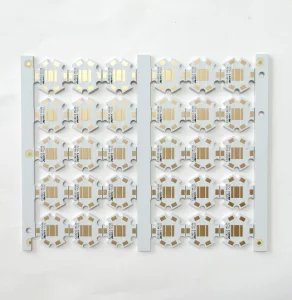
Transitioning from standard 5052/6061 aluminum to specialized alloys that support 5G high-frequency signal integrity while providing structural rigidity and heat dissipation.
Utilizing machine learning to optimize trace routing for thermal symmetry, ensuring no localized "hot spots" exist even under maximum load in server and AI computing boards.
In North America and Europe, our Aluminum PCBs are used in on-board chargers (OBC) and power inverters, where vibration resistance and thermal efficiency are critical for battery life.
For Southeast Asian and Middle Eastern infrastructure projects, our T6 5050 substrates provide the longevity needed for street lighting and stadium floods in high-ambient-temperature climates.
Base station power amplifiers rely on our metal base boards to maintain signal stability in remote, harsh environments across Oceania and South America.
We provide a range of dielectric materials with thermal conductivities starting from 1.0 W/m-K up to high-performance 8.0 W/m-K layers for specialized industrial applications.
Yes. 5052 is our standard for superior mechanical properties, while 6061 is offered for projects requiring higher structural strength and better machining characteristics.
Our boards undergo rigorous signal integrity and aging tests, specifically designed to simulate the mechanical stress found in automotive and aerospace applications.
Absolutely. We maintain a flexible manufacturing line that supports both rapid prototyping for startups and high-volume mass production for global brand owners.
Standard prototyping typically takes 3-5 days, while mass production orders are usually fulfilled within 12-15 days depending on complexity and volume.
 Cynovex